That’s it - I submitted the online version of the major project! Tomorrow I will hand in the physical book at LCC - then we shall see the examiners verdict… It’s been quite a journey, a steep learning curve and an (insanely) interesting process. I am really pleased with the outcome of the book and surprised at the same time, that my idea actually has materialized.
If you’d like to view the horizontal “composite version” (which should resemble the concertina book) you can do so by downloading the file via this link:
http://dl.dropbox.com/u/9254596/_viaM_final_composite.tif.zip
Un-zip the file and view it in Preview or any other similar software.This is the double-spread issuu document:
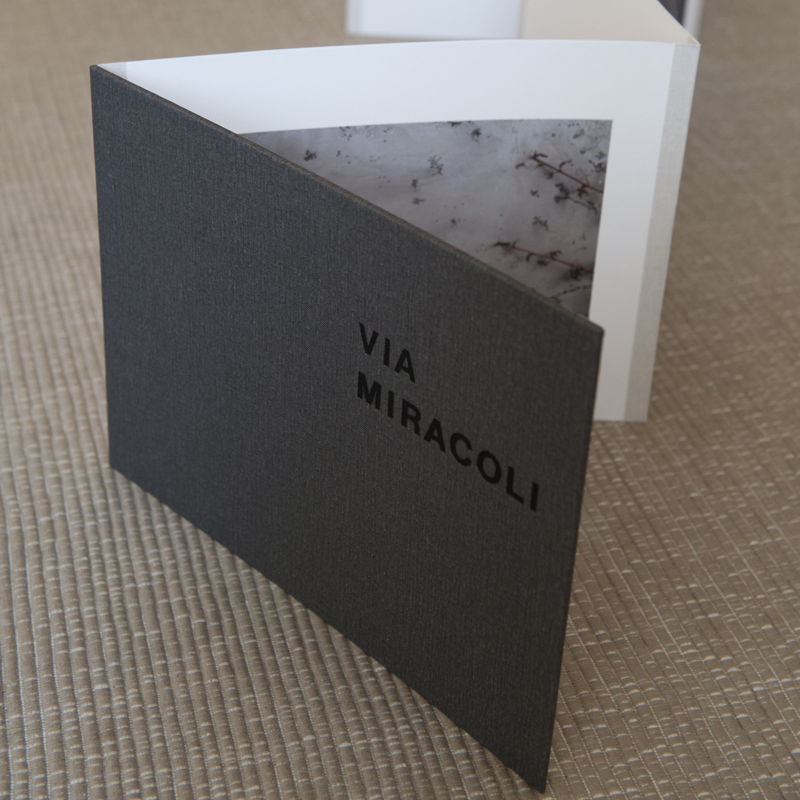
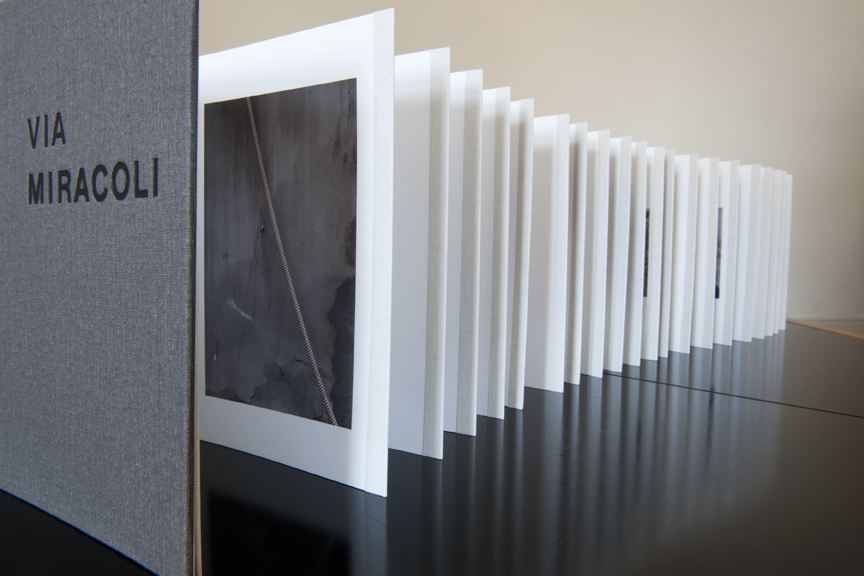
Photos of the actual concertina book can be seen here:


 Project proposal:
Porosity is the inexhaustible law of life in this city. Porosity results not only from the indolence of the southern artisan, above all, from the passion for improvisation, which demands that space and opportunity be preserved at any price.
(Walter Benjamin & Asja Lacis, 1925)
Porosity is the term Benjamin and Lacis used to explain the city in their essay of 1925 on Naples. Knowing the city well this essay, in particular their observation of the city as porous and the passion for improvisation, sounded very familiar to me. Porous is the stone Naples is built upon, the architecture certainly is porous but porosity could also be used to explain the Neapolitan attitude towards life.
Via Miracoli is situated in the Sanità - a densely populated quarter in the heart of Naples in South Italy. Via Miracoli is a typical Neapolitan stone cobbled narrow street, lined with tall old buildings where traditionally at the bottom the Basso (street level flat) is situated. The plaster of these house walls are falling down or seem temporarily fixed or not yet finished - this is not always clearly to distinguish… Layers of announcements, countless nails and and staples, religious shrines and washing lines are stuck to those walls, above all messages of all kinds creating intriguing patterns. There is a fruit and vegetable shop and a Pizzeria and Via Miracoli also is home to the one and only cemetery candle maker in the city. It’s a street bustling with pedestrians, cars and scooters. It is noisy and rather hectic.
Via Miracoli was also home to my friends: Simona Mastellone and Roberto Martillotti and their three children, they lived on the top floor of a palazzo dating from the mid 17th century just before the Piazza Miracoli. For six weeks their flat was my home and I documented Via Miracoli from the beginning to the end, the public space, shops and some of the private/intimate spaces of the people living along the street.
The aim of the project is a depiction of Via Miracoli that encompasses the many elements and facets of this micro cosmos, where the ordinary and the known becomes extra ordinary. People are not the centre of this project; it is rather their interaction with the surrounding territory they are living in. It is the almost symbiotic relationship between the urban environment and the people that forms the focus of this work.
I am inviting the viewer on a journey to follow the street as if looking through a magnifying glass; to discover the intriguing detail of the normally un-noticed, banal and the everyday object embedded in an ancient city. This work is a visual poem - an homage to Naples.
The practical work is presented as a hand crafted concertina book. On the one hand the book is thought to be an exhibition piece which re-enacts the street, hence the length of it. Furthermore the concertina book can be viewed as a book; the viewer is invited to improvise with it, to create her/his own juxtapositions of the pages. The diverse use is to reflect the ‘Neapolitan passion for improvisation’.